Monday, October 5, 2009

Another visit to the villages

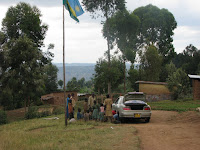
Francis invited me to join him on another Saturday drive, this time to visit villages near Butare in Southern Rwanda. We went to the Gisagara District and made various stops around Kigoma Sector and Kikongo and Kagusa villages.
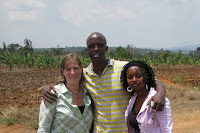
I invited my colleague Kathie (left), who recently arrived in Rwanda but will be staying for at least two years. I wanted her to meet Francis in the hopes that I can continue to help him and stay in touch especially through her. We also brought Tom (right) with us, who randomly met Francis after finding his office when looking for help this week. Tom works for GE with an organization called ASSIST that provides medical equipment to Rwanda. He traveled here for two weeks arriving with defibrillators in his suitcases! He was thrilled to have this chance to go outside of Kigali and meet people. We also traveled with Damasen (middle), Francis' employee/supervisor for this Sector. He was very professional and obviously very involved in the work Francis has tasked him.
On our drive, we passed village after village holding their elections for local representatives. Francis and Damasen described the representatives as "wise men" of the village, while the newspaper described them as Cell Executive Committees. I learned that each village must elect at least one woman on this 5-person committee, which then accounts for 30 % representation of women in Rwanda as required by law. Damansen described one village in his sector having ten people campaigning for the five committee spots. Each candidate gives a 10-minute speech to the village, and then villagers stand behind the person they want to pick. We joked about how this system eliminates any problems with hanging Chads. Their term is five years, and only one term is allowed per person. Francis said often professors, teachers, and pastors are chosen because of their experience with organizing the community. They are referred to as wise people because they must be clever to be chosen for the position.

At one point, we were slowly following a cow repeatedly crossing in front of us. Cows are considered very important here, it would be really bad to hit one!
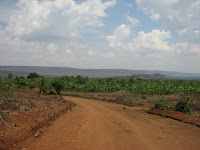
We first stopped to see rice fields near the Kikongo village. In 2008 the Mosaic Foundation provided funding for villagers to form cooperatives and buy 14 fields to be shared and cultivated for food and income. Each field costs about $300 and the cost of maintaining it for one year is another $300-400. There was a small stream running through the fields. I learned later that many people from the village come here for their main source of water, which is not good because it is pretty dirty!
We walked around the fields and talked about how many people it takes to cultivate a field with few tools, how they carry the rice plants on their heads when it is ready (without bikes or wheelbarrels), and how they water the fields with buckets (no irrigation system or pumps).


The field had healthy rice plants growing, but also many weeds (since there is no fertilizer or process to rid these besides people pulling them). The ground was extremely dry. I thought many rice fields are submerged in water, but I guess it is not required with all varieties.

We drove on dusty roads through villages, and Francis often described the road as their "highway".
Francis pointed out that he has targeted these villages primarily because people are very spread out on rough and dry terrain. He feels this is a particularly remote area where not many development groups come to visit.
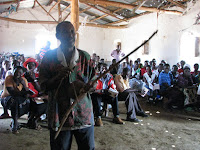
We stopped in the Kigoma village at a building created by Mosaic Foundation for their literacy and other community programs. People were gathered and singing for our arrival. They were extremely joyful in their singing.


We talked with them for about two hours. We each gave a short speech about why we were there, and shared some positive messages. They told us about their hardships with lack of clean water; difficulty getting to the health clinic; lack of money to buy health insurance; the need for more land for planting soy beans; and more safe, clean houses for the poorest in their village. Much of what they said was similar to my other visits on previous weekends, however a few new things included a number of returned prisoners (who committed genocide crimes 14 years ago, and have now re-joined this area) complaining of stigma and lack of opportunities; a few school children had finished secondary school but do not have the money to take their exams and there is no hope for opportunities after the exam; a surprisingly large group of children indicated they are stigmatized because they have "mental illness" because they fall on the ground alot and can't remember what happened (I think there is a greater prevalance of epilepsy in Africa than Western parts); and a number of children brave enough to say that life is hard because they don't know their fathers and their mothers have more than 5 children (showing a lack of family planning education happening; as well as possible prostitution for income).
One of the most touching moments for me was when Francis told the group I was getting married and they each went around and said a variety of enthusiastic blessings for my wedding including: good health, a home full of peace, and life with much wealth. I was astounded at how willing they were to wish my life well, while clearly their lives are so hard.
The group was happy to take pictures with us. And we took time to show them the digital images after each photo.
Many people followed us to our car and wished us safe journeys and said "Komera!" which means courage.


Francis wanted a photo with this family because he pays for these children's school fees out of his own pocket, after seeing them in very bad living conditions not long ago.

We also stopped by a beehive project that Francis has been involved in creating.


Lastly, we traveled to the Kagusa village and stopped to visit this group. They were singing and drumming when we arrived.

Unfortunately we only were able to give short speeches and greet the group because the sun was setting and we needed to be on our way back to Kigali.
They were all so happy to see Francis, it was clear they feel he has really helped them.
I plan to to ask my colleagues and our grantees some questions related to my journey from the weekend, including: what are we doing about basic life and health needs such as housing and clean water; how are we trying to impact the local government about the prohibitive cost of health insurance and providing opportunities for villagers after secondary school; who is working with villages on the re-entry of prisoners to remote places; and what kind of health messages are we conveying at the village-level about family planning and addressing stigma surrounding health conditions such as epilepsy. I believe the US programs are trying to impact many of these issues but I learned first-hand that often the challenge is getting the resources and policy changes to reach the village level. I really appreciate that people like Francis are trying to provide a safety net for those families that don't have or can't access the national programs, and to help identify their unique needs that have not yet been addressed at the national level.
-------------------------------------------------------------
I also wanted to post this smiling picture of my favorite 6 and a half year old in Kigali, Malcomb. I went to lunch on Sunday with he and his dad, who I have not seen in a while. Malcomb is one of the most energetic and happy kids I've ever met (and he is an incredibly talented dancer already!) His mom is in the States having a little brother or sister for Malcomb soon. I hope I get to meet their new family member too.

Friday, October 2, 2009

Bags, Bagels, and More

On Fridays our offices officially close at 1pm because all other weekdays we work 9.5 hour days. Sadly it is not often possble to take the afternoon off for many of us, since there is plenty of work to continue the full day on Fridays. However, as my time nears to a close in Rwanda and the office is staffed with my replacement, things have slowed enough for me to take my Friday afternoon off.

I called my trusted cab driver and friend Banner, and explained my errands for the afternoon. I had him take me home to drop off my usual US Embassy Friday commissary goodies (Diet Dr. Pepper, pickles, applesauce, etc) and pick up my gorilla hiking sticks. He laughed when I brought them back to the car, wondering if I was going hiking somewhere. I explained that I wanted to have a carrying bag made for them so that I can bring them home on the airplane. He thought this was pretty funny. I asked him to take me to Ineza, which is a Cooperative of women living with HIV/AIDS who sew and sell bags and other fabric goods. I've been there many times and have become friends with the supervisor, Maria. I always stumble through my choppy french when needing to explain complicated things like ordering a hiking stick bag. There were about 30 women working hard this afternoon. There was also a young American woman walking around looking frantic. Maria began to measure my hiking sticks and brought three others over to chatter in Kinyarwanda considering and discussing how a bag would be made for these sticks. The frantic American woman came over to explain that she was trying to get the women to complete a bag order for a large conference in California. She said the bags have to be shipped by Monday to get there in time, since there was a major delay in the project when the fabric company initially sold the women fabric with a drug company logo on it; which would not go over well at the conference. She seemed very stressed about this situation. I've always thought it would be really neat to order these colorful fabric bags for a conference, but I am not surprised there would be unique challenges to get the order completed. Maria happily arranged for my bag to be made and I agreed to come back in a week. I couldn't help but buy three other cool fabric items before leaving. I wished the conference planner luck and was off to my next errand.

I had heard a while back that a "bagel guy" exists in Kigali who will make custom-ordered bagels every Friday. This week I figured I would place an order. My colleague drew a complicated map to get to the "bagel house" and explained that I needed to send the order by text on Thursday and then pick them up between 2 and 4pm. When we left the bag place, I pulled out the map and rather than try to interpret another hand-drawn, no-street-name Kigali map...I turned to Banner and asked him if he knew the Bagel Guy. Not surprisingly- he did! He promptly drove me down a cobblestone road to the bagel house. The sign on the gate said "Speak- I Listen". I opened the gate and the house was pretty empty with sparse furniture. I walked to the back yard and saw a small separate building, which I figured was the kitchen with ovens. When I came to the building there was a guy with mounds of flour on tables. He smiled when I greeted him. I pointed to the mounds of flour and said- let me guess, those are my bagels? He laughed and said that everyone picks up their orders between 4 and 5pm, so my bagels were not made yet. Oops! I agreed to come back at 4pm and left again with Banner.

We then drove to Kablaki, a Cooperative of local craft sellers together in an alley with about 30 kiosks. It's always a busy place with at least 5 shopping tourists, and all the sellers vying for you to visit their kiosk and buy something. I had been there recently and found the perfect wedding favors...I had been negotiating buying them in bulk with one of the sellers named Claudine. I found her again and continued negotiations, trying to get the size and color for the price I wanted. She finally agreed! I noticed a man was standing near the kiosk watching us, and when I asked about him she said he waits to take 10% from each sale for the Cooperative. She asked if I would meet her at the gas station down the road to pay the deposit and avoid the 10% overhead for this bulk order that she would make directly from the distributer. I nodded and quickly purchased a small key chain so I could turn and smile at Mr. 10%. Banner then drove me to the gas station as I explained that I needed to pay a deposit off-site. He was skeptical that I should pay so much money without any product yet (an unusual thing to do here, although an order of this size is also unusual.) He pulled out a notepad and a pen and suggested I write a receipt for my plan. Good thinking Banner! So, I wrote out two notes explaining our agreement and specified the due date while we waited for Claudine to arrive. I then paid the deposit and she signed the agreements, while laughing at my jokes about us being secret gas station business women.

Unfortunately when we returned to the bagel place at 4pm the bagels were not ready. I sat down and introduced myself to a woman in the main room of the house named Beatrice. She looked tired and I asked if she had a long day. She said she had counseled over 100 women today! I learned that the bagel house is actually a local non-profit organization which counsels women and families grieving over the genocide or other losses in their families (and sells bagels on the side). I began chattering with her about social work and counseling. She is a wonderfully knowledgeable nurse who counsels hundreds of people in Kigali and in other provinces. We compared notes from our experiences conducting grief and PTSD therapy groups. When I described some of the tools and activities I've learned and used in the past, she mentioned how few books she can get her hands on for these techniques. I learned my bagels were ready, so we exchanged numbers and I told her I would introduce her to my colleague Kathie who I could try to send some books once I got home. It was so nice to meet and spend time talking with Beatrice.

When I got back to the outside kitchen, the bagel maker pulled the large wooden spatula out of the wood burning stove with just my six steamy bagels (3 cinnamon raisin, 3 everything) on it (why did I forget my camera today!?) He then asked where I would like to put them. I hadn't thought about bringing an appropriate bag! I quickly emptied everything from my handbag into my pockets and had him place the hot, fresh bagels in my purse.

As we drove back to my apartment Banner mentioned that he has driven a number of people to the bagel place before but had never seen a bagel. I told him he was in-luck today and quickly opened my steamy purse. I plucked out an everything bagel and handed it to him. He said- oh, it's round bread! He asked me what bagel means, and I told him I wasn't sure of the origin but to me it means round shaped bread with a hole in it. I told him it was an everything bagel and he asked "everything of what?" That's a tough one to answer, so I said everything they put in all the other bagels. He took a few bites and said it was surprisingly soft bread. He asked me how long the bagels would last and how would I prepare them after a few days; would I put them back in the oven? I told him I would toast them, and then had to describe a toaster. He laughed at my silly American ways!

Tuesday, September 22, 2009

An article in the Washington Post by the President of Rwanda

Why the U.S. Needs Africa
(http://www.washingtonpost.com/wp-dyn/content/article/2009/09/20/AR2009092001296.html)
By Paul KagameMonday, September 21, 2009

Africa and the United States may be on the verge of a new partnership, not one of dependency and aid but one of shared ideas, vision and investments that increase our mutual prosperities. To begin this improved relationship, both must accept urgent and substantial changes in the nature of our bond.

Africa needs to acknowledge a key tenet of President Obama's July address to Ghana's parliament: that a vibrant private sector is critical for capable, reliable and transparent societies. Without a dynamic private sector, no society can prosper. The African continent has been slow to foster conditions that build active private enterprise.

Africa must adopt policies that strengthen governance and promote economic growth to create conditions for a strong and innovative private sector. These are the most durable strategies for advancing socioeconomic transformation.

Like all nations, my country is not perfect, but Rwanda continues to build strong foundations for stability and improve standards of living for all of our people. This has led to greater social integration and gender equity. Rwanda has leveraged the contribution of women for its productivity and prosperity; ours is the only country in the world with women as a majority in parliament.

Rwanda has moved from instability to reconciliation and sustainable development largely through our Vision 2020 strategy. The primary principles of this strategy include macroeconomic stability; wealth creation to reduce dependence; and a shift from an agriculture-based economy toward a knowledge-based economy, with a vibrant service sector. We have enacted and consistently enforce a rule of law that counters corruption and supports our ambitious reform agenda. Secretary of State Hillary Rodham Clinton acknowledged our progress, and the importance of "policies based on evidence and measurable results," during an Aug. 5 speech in Kenya. Rwanda's ranking as the top global reformer in the World Bank Doing Business 2010 report illustrates what can be achieved with vision and engagement.

The recommendations in President Obama's July 11 address are as pertinent for the United States as they were for Africa. Africa's prosperity, he said, "can expand America's prosperity. [Its] health and security can contribute to the world's." The link between the U.S. economy and African markets is critical, especially given global economic conditions and the potential Africa represents as a profitable new market.

It is no longer enough for the United States to work for Africa based on pity; the United States must work with Africa to build both our economies and improve the lives of all of our people. The United States has long supported assistance to Africa. The United States must recognize that Africa is now in a position to be of assistance to the United States. It is time to acknowledge our mutual reliance with clear actions. Yes -- Africa must improve its governance institutions and embrace private-sector development. We appreciate the African Growth Opportunity Act and acknowledge that Africa has not fulfilled its potential; African countries should take responsibility for shortfalls in their efforts and take greater advantage of opportunities under this act.
Meanwhile, the United States should increase financing to U.S. companies wishing to do business in Africa through key financial institutions such as Export-Import Bank of the United States and the Overseas Private Investment Corp. The United States has committed less to African markets than the emerging economies of Asia have; China guarantees nearly 30 times more in loans for investment in Africa than the United States does. Africa's needs are so great that there is ample room for both U.S. and Chinese investment. Increased U.S. investment in Africa would translate into more opportunities for U.S. companies, with high potential for profit flowing back to the U.S. economy.

The United States should also support regional initiatives in Africa. Africa's economic development does not stop at national boundaries. Our markets need to be connected by better roads, by canals and ports, and through new technologies. Yet few U.S. companies are competing for large-scale and regional projects.

The development of regional trading pacts similar to the North American Free Trade Agreement is among Africa's highest priorities. Regional development would better allow U.S. products and companies to reach beyond individual countries to greater markets without the burden of tariffs and legislative burdens.

As I meet with President Obama and other world leaders this month at the U.N. General Assembly in New York and the Corporate Council on Africa's U.S.-Africa Business Summit in Washington, I will remind them that development assistance to Africa is important but that the best type of aid leads to investment in national infrastructure and private-sector reinforcement. Without a vibrant private sector, there can be no economic growth or development. If the U.S. private sector played a greater role in Africa, mutual development would follow. To achieve this, the Obama administration must facilitate U.S. investment in Africa, and African leaders must attract greater U.S. investment by consolidating our institutions for effective governance.

The writer is president of the Republic of Rwanda.

Monday, September 21, 2009

Paintings for Paul

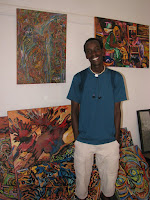
Richard is an artist at the Ivuka Art Studio in Kacuyiro, Kigali. He and I have become good friends while working together on a project he is proposing to paint murals in health centers and schools. I hope to see the project move forward before I leave, but I only have one month left in Kigali and am not sure I will see completion of the project. Richard is a very hardworking and big-hearted young artist. I wanted a chance to help support him directly so I commissioned a series of paintings for Paul (and I).

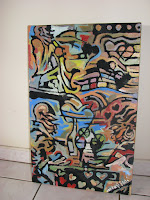
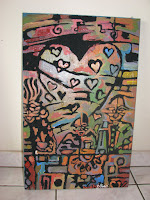
Richard has a unique style where he crumbles charcoal and adds it to his paintings for a 3-D effect. He uses bright colors too. I asked him to do a series of three paintings for Paul and I, depicting love and family. He created three very beautiful paintings for us.


I am happy these paintings will always remind us of Rwanda and Richard. Let's hope I am able to pack them securely in my suitcase!

Thursday, September 17, 2009

Mourning Titus, the Gorilla King

Last night I attended a presentation given by Katie Fawcett Director of the Karisoke Research Center, funded by the Dian Fossey Gorilla Fund. http://www.gorillafund.org/

Katie gave a really interesting and engaging overview of Dian's early work identifying and learning from these gorillas, and the organization's 40 years of tracking and researching the gorillas. I have a new understanding of the hard work the Rwandan park rangers and gorilla guides put into protecting the Mountain Gorillas in Rwanda.


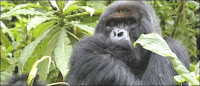
I learned the sad news that the most famous silverback in Africa known as Titus - has died in Rwanda at the age of 35. He was considered a handsome gorilla and was easliy recognized by the brown marking on his brow. His group of gorillas is currently moourning him and staying near his body on the mountain; cleaning it. They are discussing when to hold a burial and plan to bury him on the mountain near Dian Fossey and other beloved gorillas.

After the presentation we watched a BBC documentary of Titus, "the Gorilla King". He was described as "possibly the most remarkable gorilla ever known", referring to his long life and his rise to dominance in his group. He was one of only about 700 mountain gorillas left in Africa. Mountain gorillas are found only on the slopes of the Virungas on the borders of Rwanda, Uganda and the Democratic Republic of Congo, none are currently held in zoos. The plight of the mountain gorilla was brought to the attention of the world by Fossey, who lived in the Virunga until her murder in 1985. Titus was born on August 24 1974 and has been observed closely by researchers throughout his entire life, and he died of old age on September 14. The life expectancy of a healthy gorilla is about 40. Looking at the film and written documentation, Titus' story is very heartwarming with him rising to become the dominant male in his group despite losing family members to poachers in the 80s and being born underdeveloped.
Katie indicated that much of the success of the Dian Fossey Gorilla Fund, and the rise in population size of this critically endangered animal is reliant on individual donors and people who become "members" on their website. http://www.gorillafund.org/

Tuesday, September 15, 2009

Inspirational Visit to a Village

An Introduction to Mosaic Foundation...

A few weeks ago while waiting on a friend's arrival at Kigali Airport I struck up a conversation with Francis who was there visiting a friend. We started talking about Rwanda and our work. I learned Francis started a non-profit called Mosaic Foundation nine years ago with funding from two international religious organizations. Mosaic's mission is to fill the gaps in the lives of Rwandans in poor and remote villages. Francis focuses much of his efforts on what he calls "home affairs" in four discricts (out of 30) where he implements literacy and life skills training for women and children in remote villages. He also conducts activities on cultural understanding, recreation, and reconciliation. His organization's annual budget is about $60,0000 with 20% generated from renting part of the building their offices occupy. Francis helped create "clusters" of local non-profits in each of the four districts where he works. When he finds village needs out of his reach (houses, water, livestock, etc.) he partners with the other cluster members to get what is needed if possible.

As I've gotten to know Francis, I've learned a lot about his passion and inspiring work. He was born in Rwanda but was orphaned at a very young age. His early memories include a very difficult life in Burundi as a refugee and sleeping on the dirt ground in a kitchen for a number of years. He attended boarding school for high school and saved money by selling individual cookies out of larger pack to the rich school children. In his years after school he served as a soldier in the RPF in Rwanda, and also attended seminary for some time. He recalls hard moments as a child where he sought spiritual answers to his questions of why he had no parents, and how he could find educational opportunities. He says he made promises to himself and to God that he would help others if he were given the opportunity to learn and have resources. He never attended University, but later worked for the government for a few years at the Rwandan Embassy in Kenya. At that time he felt he was not doing enough to help others and live up to his promises so he left to start his own organization. His friends and colleagues thought he was crazy to give up stable resources and income, but he looks back with no regret over being able to create his own mission and help others. In every conversation with Francis, his passion and love of his work shines through. His lack of university education but keen business mind is admirable. He created a Board of Directors and invited individuals to become members of his organization. He employs four administrators in Kigali and five community leads in every district where he works. Francis' impact on the villages and his unique relationship to so many children and families in Rwanda is incredibly important and impactful.

I showed Francis the public library at the US Embassy and talked with him at length about the things I've studied and learned about nonprofit management. I shared ideas with him about creating a website and communication materials, organizing his fundraising, and focusing his mission on measureable outcomes. He is thrilled to hear these ideas and thanks me profusely; of course this is a simple thing for me to do. I've given him some of the management and social work books I brought to Rwanda and he is always eager to learn more. In return, he invited me to visit his projects in Rwanda. I am humbled by this invitation, and happy to see all that I can.

In my job managing US Government programs in Rwanda, we work with the local government to build national health care capacity and with international partners to implement large scale HIV/AIDS programs. Meeting Francis and seeing his work, fills an important gap in my experience here allowing me to see aspects of poverty and needs in Rwanda that are not HIV/AIDS-related. Also, it helps legitimatize my experience through talking with people in the village and seeing first-hand their struggles. I am proud to know and join Francis at the indvidual level and the village level. There is something to be said for seeing one problem and doing what you can to solve the problem immediately. We need individual-level support in the world as much as we need large efforts of developed countries helping poor countries to fight infectious diseases and improve health systems. Both levels create a healthier world; and I want to be a part of both levels.

Our first Saturday trip: Eastern Province, Kayonza District, Mweri Sector, Kigarama village.

We drove about two and half hours outside of Kigali reaching dirt roads on the winding hillside. I travelled with Francis, Concorde (who drove us) and FiFi his secretary (below.)


Francis chattered about the statistics of this sector- 22,000 people; 39% illiterate; 95% rely on agriculture for income.

We walked to a remote village on paths like this.

In the village we joined a community meeting led by one of Francis' program leads. This group gathers for Francis' 9 month literacy education programs and anytime Francis comes to the village so he can check-in with the community. An elder in the community came forward with a traditional musical instrument (umuduri) and played a song for us and then wrote his name on the chalk board. I was introduced to the group as a friend of Francis' and unexpectedly asked to give a speech about my work, and my reason for visiting. The group shared about their concerns and problems to Francis and I. Many remarked how hard life is and how tired they are from carrying heavy things and walking far to get water and health care. Others mentioned alcoholism and gender inequality as great hardships. One person felt the water is not clean and contributes to eye, teeth, and kidney problems in the village. When asked about health issues, people mentioned malaria, skin disease, TB, teeth, and eye problems. When given the chance to ask me questions, the group asked how they could get medicine since the health clinic is often to far too reach, and what do we do about domestic violence in the US. I fielded questions the best I could for about 30 minutes. One young girl asked if I was married- that was an easy question! I felt exhausted after this meeting. The number of problems is overwhelming and feeling helpless for answers is difficult to endure. I took some solace in being able to offer them understanding and letting them know I cared for them; but of course it feels not enough.


After the community meeting, I was introduced to a local female soccer team. They were very proud and excited about this group, as it is unique to have girls involved in a sport. I asked who the team was playing against and they mentioned they had not had a soccer ball for about 6 months now.

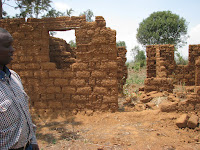
Francis showed me that homes are often made of mud bricks but a better sturdier way is to use cement bricks.

One of the organizations in the cluster has been conducting a project to teach this village how to make cement bricks.
Francis is most passionate when he sees a family or children living in substandard one-room homes (which is fairly common in Rwanda). He says it brings up his own painful childhood living in these conditions. On this day I visited many one-room homes. It was hard to see. The houses were bare and had only straw mats for sometimes 5 or 6 family members to use for sleeping. In more than one we learned the family members were sick with allergies and asthma, sometimes sleeping inside with animals as well. Here is one family in front of their original one-room house with a skimpy thatched roof.
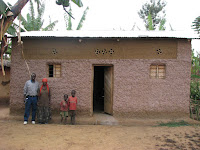
Francis and his cluster helped build this much larger five room home, and now this family uses the smaller structure as a goat house.
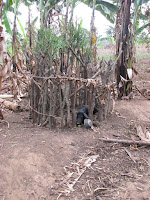
They also have a pig in the backyard indicating their income and resources have improved.
In another area of the village Francis has planted trees for firewood as an agriculture and income-generating project.

Francis is particularly proud of an area where he planted 1,000 mango trees in the yards of local families. He gave many of the trees directly to the woman in the household so it is seen as hers, and if the husband leaves he cannot take the tree with him. These trees will provide food and an opportunity to sell the fruit. Francis would like to expand this project in this and other villages if possible.
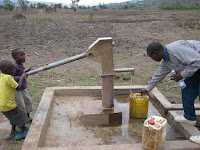
There was a well in-between two of the villages we visited. Many people feel the iron in the water causes stains and bad teeth.
Next we visited a neighborhood of 39 homes built by a partner in Francis' cluster. Francis helped identify the area and choose the families to receive homes.

Francis introduced me to the families living in these homes. I spoke at length with two single mothers and their children. They told me a little about their lives and asked me a lot of questions about mine.

This is Odette who has six kids. She married a soldier who died. She told me her life is very hard and she wants to make a better life for her children. She is happy to have a home in this group of new houses, but wishes she had means for income such as livestock or a sewing machine. I asked her what she would change if she were mayor (which made her giggle) and she said she would better the lives of the children in the village. Often they are turned away from school because of poor clothing, no shoes, or illness.
This is Sovia who has 4 children and was married when she was 9 years old in Uganda to a man with multiple wives. She left him and fled to live with her mother in Rwanda who has since passed away. She echoed her friends words of wanting to help her children. She had many scars on her neck and chest but didn't mention what has happened. She said she wishes for eye glasses for her children, and medecine for skin and eye allergies.

The children gathered around and sang many songs for me.


At the end of the day we returned to Kigali. I wished I could solve every problem that I saw throughout the day. After having worked in HIV/AIDS programs for nearly a year, I was overwhelmed with the number of basic care issues faced in the villages including other health (skin, teeth, eyes), food and nutrition, housing, and clean water. I found myself asking people all week about the impact our programs have on these issues. A lot of people agreed it is difficult because the HIV/AIDS money is directed by the US Congress to fund specific activities, so we can't make a larger impact on these general needs in Rwanda. This gap is more often filled by aid from other coutries or international NGO and faith-based support.


Our second Saturday trip: North Province, Gicumbi District, Byumba Sector

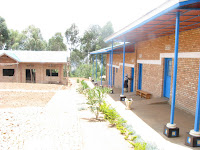
The next Saturday I travelled again two and a half hours outside Kigali to visit other programs with Francis and Concord. This time we visited a District office and met the Social Affairs Director for the district. He spoke very highly of Francis and indicated how much he has helped the District. As we drove around, it was clear this area was a wealthier area than our last trip. Francis thought this might be because the ground is a little more conducive to growing, and the elevation keeps bugs and mosquitoes away. We stopped at a private hospital funded by someone who came to visit this sector in 2007. The visitor recognized that a small health clinic funded by the District was not sufficient for this sector so they donated funds for this new clinic through Francis and the other cluster partners.

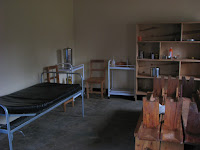
I toured the surgery room (below) and the maternity ward.

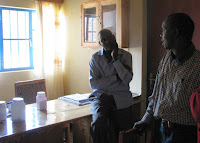
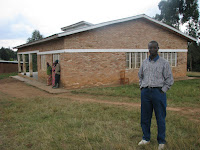
I met a nurse who said there are no doctors to staff the facility yet. He showed us a stark cabinet in the pharmacy. He indicated he would like to go to school and become a doctor, but has not had the opportunity.

Next we visited a community center/town hall in one village. Francis explained that he uses this location to reach out to over 300 Twa community members (Pygmy people, first inhabitants of Rwanda now 1% of the population; it is believed that 30% of their population died in the genocide). The Mosaic Foundation community employee in this area has been teaching a literacy program for this group over the past nine months.

Some of the group came to greet me and sang songs for me. Similar to the previous weekend, they all shared about their community concerns and had a chance to ask questions. Many of them thanked Francis for helping them to learn to read and write. At least two people told of letters they could now read and write. Many of them said it is challenging because they can read but they don't have access to books or paper/notebooks to write. Some of them mentioned domestic violence and prostitution as the biggest problems in their community. They asked me questions about what widows do about raising children alone in the US, and how do we discipline our children. They indicated they wanted tools for income generating such as carpentry, brick-making, and sewing tools; and things to read such as books about skills.

After speaking with the group our departure was delayed a bit by a flat tire. Many children gathered around to watch the changing of the tire.
These visits with Francis have had a big impact on me. I understand the problems and village life a little clearer and am thankful this will enhance my ability to impact program development and management at the macro/government level. On a personal level, it is a struggle to see and listen to so many problems and not have immediate answers or ways to help. Francis' motivation to tackle every problem heard is appealing and I hope to help him as much as possible. We crunched some numbers together to consider some of the costs are associated with the needs we heard.

1. $5,000 to build one house

2. $3,000 to grow 1,000 mango trees

3. $50 to buy one soccer ball in Rwanda

4. $3 per year to buy health insurance for one family member

5. $15,000 to buy carpentry, sewing machines, and brick making supplies for one year

Francis' philosophy is to look around to see who is being left behind, identify and provide what they need to get caught up with the rest of us. Many of us do this; some of us look to help family, or neighbors, or immediate community. Others help their country or global efforts. Rwanda has a special place in my heart; I want to see people have basic needs met and an opportunity to prosper. I would like to raise money for Francis and do whatever I can to help him help these villages.