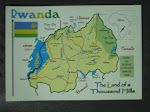


(Friday 6:15pm in Dulles on the tarmac...) I have a whole row to myself on this leg of the trip. Row 39 EFG. Lucky me! Now I can stretch out. It's already strange on the plane- no one is speaking english around me. I hear french, german, and dutch. All of the ennouncements are in multiple languages. The flight is 6 hours and 12 minutes. They are showing a series of movies 3 different times during the flight. I can choose from Flash of Genious, Secret Lives of Bees, Nights at Rodanthe, Dutchess, Max Payne, Rachel Getting Married, or Burn After Reading. I think I'll choose Rachel Getting Married. There is a picture of a plane and a map on the back of the seat in front of me. We are still over the U.S. heading up the eastern shore.
(Saturday 15 hours later...) I'm the second leg of the trip now. I had a good flight to Brussels and arrived there at 7AM. I always forget how hard it is to transfer internationally. United Airlines did not print an actual ticket for my flight out of Brussels so when I went through customs they told me I had to leave the international terminal and go to the ticket counter at the front of the airport. I had to wallk very far to go outside and then back in a long line at the SN Brussels desk- the American Airlines partner. They couldn't find any reservation for me. It was scary for a moment. But I stayed persistent and asked for a supervisor, etc. I explained 2 or 3 times that I flew United and was switching to American Airlines (complicated by the fact that I was at the SN Brussels desk because they are the carrier...) Eventually they called United and it got sorted out and they found the ticket. whew. As it turned out when they talked to United, they learned my bags had been offloaded in Brussels by United. So, I had to walk down to baggage claim and pick out the 5 bags! I guess this is the silver lining, because I would not have learned my bags would not have made it, if I had not had to go out to this airline desk. Unfortunately they also told me that SN Brussels only allows one carryon bag...so they made me check my other one. (NowI have 6 checked bags!! This was particularly stressful to me because my carryon bags were jammed full of expensive electronics and migraine medecine. I watched it go away on the baggage carousel with fingers crossed that I would see it again soon!
My layover in Brussels was from 7AM-10AM. I wondered around the International terminal looking at the duty free things. I was reminded of how Belgium is an english speaking country but I think french is the preferred language. There is a little hint of annoyance when you ask people to speak english (airport personnel and store clerks). I wasn't brave enough to break out the french yet., but will have to soon. I am always a little shy at first- the accent is so hard. I
stopped at a cafe and bought a "jambon and fromage" (hame and cheese) baguette for 4 euros and a coke light (diet coke) for 2 euros. That was an expensive snack!
Every time I wake up from napping on the second flight (7.5 hours long!) I spend time watching a Rwandan woman accross the aisle from me with her 1 year old little boy. This flight is full, so she has to hold him in her lap the whole time. Besides the fact that the baby boy is adorable, smily, bright eyed, and very active...I am struck by how "universal" her mothering is. She is speaking french while singing lullaby's to him, keeping him from chewing on the seatbelts, giving him high "fives", waving at him, and pretending to be a train when feeding him. There is something so heartwarming to see universal human behavior. Part of my reaction is feeling validated that everyone should be themselves, especially in uncomfortable scenarious like traveling in a new country or being in a new setting with no one speaking your language...it's calming and amazing to be reminded that we are all human and much of who we are is natural and shared regardless of place or language.
Other random thoughts on the plane:
-the food on planes is BAD. Wish I'd packed some granola bars in my carryon bag.
-it's cold on planes! Wish I'd put a jacket in my bag too. I've had to sneak 3 airline blankets to stay warm. brrr.
Wait!...SN Brussels just handed out swirled chocolate and vanilla ice cream cups and warm hand towels. What was I saying about bad food on planes? All is forgiven. haha
(Saturday 8:30pm, arrived in Kigali...) Our CDC driver Syla picked me and my six large bags- which all arrived thankfully, up at the airport. Syla told me Kigali has been waiting anxiously for my return. :) He took me to my apartment- in the same building as the last time I was here for 3 months. It is a slightly bigger one-bedroom- with a full size kitchen this time. It is furnished with a TV with cable, microwave, and much of the kitchen stuff and linens that I will need. I mailed about 10 boxes too- so once I have that stuff it will look more like home. Daniel came over and brought me welcome goodies including toilet paper, paper towel, bottled water and snacks. So nice!! I totally forgot those were the essential things I needed upon arrival. We are off to go out with friends tonight- Daniel is leaving Rwanda again and I am filling in for him again. He needs shoulder surgery which will take 6 months, so this is his last weekend in Kigali. I am tired from traveling...but how can I pass up a last weekend night out with Daniel before he goes?! It will be great to catch up with friends tonight too. Packing and resting can wait until tomorrow...
Sunday, February 8, 2009

Friday, February 6, 2009
On My Way!
9 hours before departure....Today I am finishing up last minute details, re-packing my six suitcases (thanks to CDC for excess baggage allowance), headed to the bank, pondering what really has to go in my carry-on bags. I learned a lesson the first time I went to Rwanda: the lighter the carry-on bags the better while walking through airports!
I leave today at 6pm from Dulles airport with a 5-hour layover in Brussels tomorrow morning, and I arrive in Kigali at 7pm on Saturday. I can't remember whether it's best to sleep on the first flight or the second flight or not at all?! Oh well, I'll figure it out and probably sleep whenever I am tired anyway.
I have an apartment arranged in the same building I lived in last year, but a slightly bigger place. It's great because it is furnished and only 3/4 mile from the office, so I can walk to work. I learned from a co-worker in Rwanda that Kigali is as beautiful and sunny as ever right now. I can't wait for the 75 degree weather everyday!
I was very happy to hear today that the person picking me up in Kigali will have keys to my apartment and a cell phone for me. Yay! I am thankful that I will not be wondering around the airport or trying to get 6 bags into a taxi. I also got an email invitation to go out dancing Saturday night. I will be exhausted...but I rarely turn down an opportunity to go dancing, even after 24 hours of travel! It's so nice that I have been there twice already and so many friends are still there.
I am very sad to leave DC and all of my friends and loved ones. I've had an amazing last week. Paul threw a fantastic goodbye party in the party room of his building with lots of dancing and karaoke. I ate yummy food this week that will hopefully last me throughout my 8 months away...Oysters (my very favorite!), sushi, steak, and Ethiopian food. Fun activities included a superbowl party, movies, Air & Space Museum in Virginia, ice skating, and a fun wine bar. I am so thankful to my friends who helped move my stuff into storage and helped organize the party last weekend. Also, a huge thank you to Paul for taking time off this week, helping me take care of everything, and taking me to the airport today. I could not have done this without him.
Many more Rwanda adventures to come!
Tuesday, January 6, 2009
Preparing for a return trip...
I am once again counting down to a departure date for a trip to Rwanda. I am thrilled to have been asked to return and serve as the CDC Senior Program Manager of Cooperative Agreements (contracts) with organizations providing HIV/AIDS prevention and treatment programs. I will be on temporary loan from NIH to CDC from February through October 2009. I look forward to this new adventure and am excited to offer continued assistance to these important programs in Rwanda. Now, back to making lists, packing....
Tuesday, October 28, 2008
Women in Rwanda


The Washington Post has published interesting articles recently about the role of women in Rwanda as politicians and business owners.
"Women Run the Show In a Recovering Rwanda"- October 27, 2008
http://www.washingtonpost.com/wp-dyn/content/article/2008/10/26/AR2008102602197.html?sid=ST2008051504314&s_pos=list
and
"Women Rise in Rwanda's Economic Revival"- May 16, 2008
http://www.washingtonpost.com/wp-dyn/content/story/2008/05/15/ST2008051504314.html?sid=ST2008051504314&s_pos=list
Thursday, September 4, 2008
PEPFAR II: Big Picture
Background
In May 2003, Congress approved and President Bush signed into law, the "United States Leadership Against HIV/AIDS, Tuberculosis and Malaria Act of 2003" This legislation approved expenditure of up to $15 billion over 5 years.The program known as the President's Emergency Plan for AIDS Relief (PEPFAR) spent $18.5 billion over those five years to prevent HIV infection, treat people with AIDS, and provide care to orphans and vulnerable children. PEPFAR is "the largest commitment by any nation to combat a single disease in human history."
Moving Forward
On July 30th , 2008 the U.S. Government reauthorized the President's Emergency Plan for AIDS Relief (PEPFAR) allocating $48 billion to developing countries for their struggle against AIDS, tuberculosis and malaria. The bulk of this money, $39 billion, is for HIV/AIDS, with $4 billion going towards tuberculosis, and $5 billion for tackling malaria. The act also doubles the US contribution to the Global Fund to Fight AIDS, Tuberculosis and Malaria to $2 billion yearly.
The 2008 reauthorization act provided the following guidelines:
The U.S. is saving the lives of millions of people in the poorest places on the planet through this effort. The number of AIDS deaths worldwide dropped 10% in 2007 due to increasing access to treatment, as did the number of new infections in children. “In a surprisingly short period of time, there has been a tripling of prevention efforts in some countries,” said Dr. Paul De Lay, director of evaluation for UNAIDS.
PEPFAR reauthorization was the result of months of work by Democratic and Republican congressional leaders, advocacy organizations, foreign policy experts and medical professionals who worked together to pass historic new funding levels to fight AIDS, TB and malaria.
Bipartisan Support: McCain and Obama were co-sponsors on the the Tom Lantos and Henry J. Hyde United States Global Leadership Against HIV/AIDS, Tuberculosis and Malaria Reauthorization Act of 2008. (headed by Sen. Biden and Lugar and others)
PEPFAR II rescinded the United States HIV/AIDS travel and immigration ban, which as one consequence had prevented the US from ever hosting HIV/AIDS conferences, and even worse discouraged HIV-positive immigrants, many of whom acquired the disease in the US, from taking an AIDS test or accessing medical services.
"America’s global AIDS plan has proved to be a smart investment, paying dividends in lives saved, communities stabilized and America’s reputation in the world growing a little bit brighter. This stuff works and leaders from left and right — leaders like Senators Biden and Lugar, Representatives Berman and Ros-Lehtinen, President Bush, Speaker Pelosi and Senator Reid - put aside their differences and agreed to do more." Bono- co-founder of the One organization. 7/31/08
CONS
PEPFAR continues to require beneficiary countries to emphasize abstinence-only in their prevention efforts, a methodology supported by religious ideology, not scientific evidence.
At times this means countries have had to use essential funds in ineffective ways.
PEPFAR has a "conscience clause" allowing HIV/AIDS workers to deny services to anyone they deem "immoral." This U.S. foreign policy often promotes both stigma and discrimination against homosexuals, intravenous drug users and sex workers ironically, among those most at risk of HIV/AIDS.
A recent study in six U.S. urban centers revealed an astounding HIV prevalence of 46 percent among black gay men. In addition, the U.S. Centers for Disease Control and Prevention released its revised estimate for annual new HIV infections in the United States, a 40 percent increase, from 40,000 a year to more than 56,000. It seems possible that we have grossly underestimated the scope of the national U.S. epidemic in the past decade.
PEPFAR requires beneficiary nations to develop a national AIDS strategy, while the Bush administration has refused to create one of its own. However, Congress has just allocated $1.4 million to launch a national strategy.
Rwanda has been ahead of the curve in meeting treatment goals, but they and many of the other focus countries struggle with the following challenges:
In May 2003, Congress approved and President Bush signed into law, the "United States Leadership Against HIV/AIDS, Tuberculosis and Malaria Act of 2003" This legislation approved expenditure of up to $15 billion over 5 years.The program known as the President's Emergency Plan for AIDS Relief (PEPFAR) spent $18.5 billion over those five years to prevent HIV infection, treat people with AIDS, and provide care to orphans and vulnerable children. PEPFAR is "the largest commitment by any nation to combat a single disease in human history."
Moving Forward
On July 30th , 2008 the U.S. Government reauthorized the President's Emergency Plan for AIDS Relief (PEPFAR) allocating $48 billion to developing countries for their struggle against AIDS, tuberculosis and malaria. The bulk of this money, $39 billion, is for HIV/AIDS, with $4 billion going towards tuberculosis, and $5 billion for tackling malaria. The act also doubles the US contribution to the Global Fund to Fight AIDS, Tuberculosis and Malaria to $2 billion yearly.
The 2008 reauthorization act provided the following guidelines:
- Over half of the funds are to be spent on treatment programmes, including antiretroviral treatment, care for associated opportunistic infections and nutritional support for people living with HIV/AIDS.
- In countries with generalised HIV epidemics, at least half of all money directed towards preventing sexual HIV transmission should be for ‘activities promoting abstinence, delay of sexual debut, monogamy, fidelity, and partner reduction’. If this is not complied with then the Global AIDS Coordinator must report to Congress within 30 days on the reasons behind the shortfall.
- 10% of the funds are directed towards helping orphans and vulnerable children.
The U.S. is saving the lives of millions of people in the poorest places on the planet through this effort. The number of AIDS deaths worldwide dropped 10% in 2007 due to increasing access to treatment, as did the number of new infections in children. “In a surprisingly short period of time, there has been a tripling of prevention efforts in some countries,” said Dr. Paul De Lay, director of evaluation for UNAIDS.
PEPFAR reauthorization was the result of months of work by Democratic and Republican congressional leaders, advocacy organizations, foreign policy experts and medical professionals who worked together to pass historic new funding levels to fight AIDS, TB and malaria.
Bipartisan Support: McCain and Obama were co-sponsors on the the Tom Lantos and Henry J. Hyde United States Global Leadership Against HIV/AIDS, Tuberculosis and Malaria Reauthorization Act of 2008. (headed by Sen. Biden and Lugar and others)
PEPFAR II rescinded the United States HIV/AIDS travel and immigration ban, which as one consequence had prevented the US from ever hosting HIV/AIDS conferences, and even worse discouraged HIV-positive immigrants, many of whom acquired the disease in the US, from taking an AIDS test or accessing medical services.
"America’s global AIDS plan has proved to be a smart investment, paying dividends in lives saved, communities stabilized and America’s reputation in the world growing a little bit brighter. This stuff works and leaders from left and right — leaders like Senators Biden and Lugar, Representatives Berman and Ros-Lehtinen, President Bush, Speaker Pelosi and Senator Reid - put aside their differences and agreed to do more." Bono- co-founder of the One organization. 7/31/08
CONS
PEPFAR continues to require beneficiary countries to emphasize abstinence-only in their prevention efforts, a methodology supported by religious ideology, not scientific evidence.
At times this means countries have had to use essential funds in ineffective ways.
PEPFAR has a "conscience clause" allowing HIV/AIDS workers to deny services to anyone they deem "immoral." This U.S. foreign policy often promotes both stigma and discrimination against homosexuals, intravenous drug users and sex workers ironically, among those most at risk of HIV/AIDS.
A recent study in six U.S. urban centers revealed an astounding HIV prevalence of 46 percent among black gay men. In addition, the U.S. Centers for Disease Control and Prevention released its revised estimate for annual new HIV infections in the United States, a 40 percent increase, from 40,000 a year to more than 56,000. It seems possible that we have grossly underestimated the scope of the national U.S. epidemic in the past decade.
PEPFAR requires beneficiary nations to develop a national AIDS strategy, while the Bush administration has refused to create one of its own. However, Congress has just allocated $1.4 million to launch a national strategy.
Rwanda has been ahead of the curve in meeting treatment goals, but they and many of the other focus countries struggle with the following challenges:
- coordination difficulties amongst both U.S. and non U.S. agencies
- U.S. government policy constraints
- shortages of qualified focus country health workers
- focus country government restraints
- weak infrastructure, including data collection and reporting systems, and drug supply systems.
For more information: A report from the Kaiser Family Foundation compares PEPFAR I with PEPFAR II here.
Friday, August 22, 2008
Why not eat the monkeys?
 Stories from Rwanda pop out in conversation with me all the time. Many of them are thought provoking- like this one...
During my last week in Rwanda, I ate lunch with some of my Rwandese friends on the CDC team. They asked a lot of questions about what is different in D.C. as compared with Rwanda. I joked about how lunch at NIH is not a buffet (luckily!) and how there are not usually toothpicks on tables (which is common practice in Rwanda- maybe because the meat is tougher?). One of my friends, "A", told us he had been to Washington DC a few years ago. He had never been to the States before and stayed there for four days while in training. Here is one of the many compelling things he had to say:
A: There are many traffic circles in D.C. like Kigali.
Me: True! And similar crazy driving and lack of traffic rules in both cities.
A: In D.C. there are a lot of monkeys living in these circles.
Me: What! Did you say monkeys?
A: Yes, a very small kind with long furry tails and little hands breaking apart thier food.
Me: Oh you mean squirrels!
The group : What is a squirrel?
Me: Uhmm...rodent family I think, like rats...not monkeys.
(Laughter)
A: Also, there are a lot of people living in the circles.
The group: What! There are houses in the circles?
A: No, they sleep on the ground and cover themselves with plastic.
The group: Why? (looking to me) Is there no space for houses in the US?
Me: No, we have plenty of space for houses.
The group: Well, is there not enough building materials?
Me: No, we have plenty of materials.
The group: How do they cook food? Do they eat the monkeys?
I stumbled through an attempt to describe how and why homelessness exists in the US. I conveyed that life can get very complicated (especially in a larger city in the US) in terms of buying or renting a house/car/utilities/etc. and we have to navigate these complex systems which require a stable income. When this isn't possible, losing your house/car/etc can happen very quickly. I mentioned how some people suffer from disabilities or physical and health ailments and are unable to navigate and function in these systems. They may not have or be near family members who could help. I also mentioned post-traumatic stress from fighting in a war; natural disasters destroying homes; shifts in skill sets needed among workers; and the impact of policies/politics on government services available to adults.
In Rwanda, there are essentially no adults without a place to stay. When you do not have money to pay for a house, as a last resort you go to the forest, cut down some trees, get some mud, and make a home. And before that option, there is an open door policy among families and friends-who-are-like-family. It is understood that you can just show up to stay with them if needed. They place a high value on "families" and cast a wide net defining their family members. In my short time there I received the warmth of many friends considering me to be part of their "family", and telling me that next time I come to Rwanda I need to stay with them.
Monday, July 21, 2008
All good things come to an end
Once again my visit to Rwanda has ended (way too short this time!) In my last few days I was able to shop for souvenirs and say goodbye to many friends.
Mahita and I went to the "Gahaya Links" wharehouse- a company in Rwanda that distributes woven baskets to Macy's. We were able to purchase some of the "extra" merchandise and see some of the newest designs.

 This is the owner, Joy. She posed wearing a new proto-type of a woven necklace. It is very pretty and I told her it is sure to be a bestseller (at least I want to buy one when they are ready).
 I will miss the beutiful hillside in Rwanda and walking to work in the perfect weather everyday.
 I gathered friends and colleagues on Friday night for dinner at the Cactus restaurant which serves my favorite fish brochettes. This has also become a tradition because I had dinner there on my last night during my previous visit to Rwanda.
This is David, a CDC colleague in charge of laboratory technical partnerships and projects.
 Many of the usual suspects joined me...Noni, Josh, Kris, Mahita.
 As well as my new friends, Morgan and moses.
 Cactus is located down the street from a popular ex-pat neighborhood where some of my friends live so they come here regularly. Noni ordered some fried cheese triangles and Josh ate avocado salad (the avocados are huge in Rwanda).
 Here is my favorite fish brochette in Kigali (grilled tilapia, onions, tomatoes, rice, and salad).
 Others really love the pizza here.
 Patrick's cousins Calissa and Moses joined us for dinner.
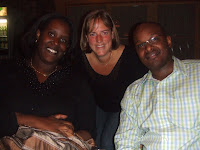
 We went to Legends after dinner and listened to Congolese music.


 On Saturday before my flight, Morgan hosted a tacos and margaritas afternoon party. It was a perfect activity before leaving Rwanda. Morgan has been house-sitting for another US Government employee who has been on leave, so she took this opportunity to cook and have people over.
 Her house, like most houses in Kigali has a beautiful view of the city.
 Morgan even had salt for the glasses. Bueno!
 I promised my friend Moses that I would take a picture of these mini-bananas that I packed in my suitcase (even though I don't think I was supposed to bring fruit into the US). We are considering how we might export these bananas in Rwanda; they are sweet and the perfect size. They stayed pretty green in my luggage... maybe it is possible to export them to the US. :)

 Many of the usual suspects joined me...Noni, Josh, Kris, Mahita.
 As well as my new friends, Morgan and moses.
 Cactus is located down the street from a popular ex-pat neighborhood where some of my friends live so they come here regularly. Noni ordered some fried cheese triangles and Josh ate avocado salad (the avocados are huge in Rwanda).
 Here is my favorite fish brochette in Kigali (grilled tilapia, onions, tomatoes, rice, and salad).

 Others really love the pizza here.
 Patrick's cousins Calissa and Moses joined us for dinner.

 We went to Legends after dinner and listened to Congolese music.


 On Saturday before my flight, Morgan hosted a tacos and margaritas afternoon party. It was a perfect activity before leaving Rwanda. Morgan has been house-sitting for another US Government employee who has been on leave, so she took this opportunity to cook and have people over.
 Her house, like most houses in Kigali has a beautiful view of the city.
 Morgan even had salt for the glasses. Bueno!


 I promised my friend Moses that I would take a picture of these mini-bananas that I packed in my suitcase (even though I don't think I was supposed to bring fruit into the US). We are considering how we might export these bananas in Rwanda; they are sweet and the perfect size. They stayed pretty green in my luggage... maybe it is possible to export them to the US. :)

Subscribe to:
Posts (Atom)